
Tuesday, October 8, 2013 – Francois Englert and Peter W. Higgs won the 2013 Nobel Prize For Physics on Tuesday. The award is given annually for the most important discovery or invention within the field of physics.
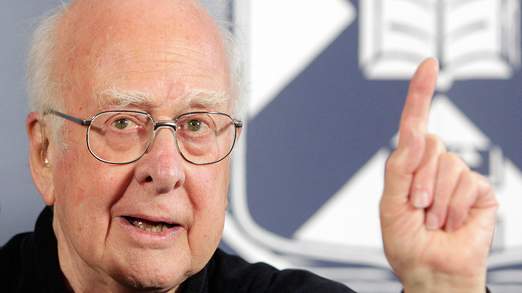
The Royal Swedish Academy of Sciences cited the two scientists for the “theoretical discovery of a mechanism that contributes to our understanding of the origin of mass of subatomic particles.”
The physics prize announcement was delayed by one hour, which is highly unusual. The academy gave no immediate reason, other than saying on Twitter that it was “still in session” at the original announcement time.
The academy decides the winners in a majority vote on the day of the announcement.
Francois Englert (Univ. Libre de Bruxelles) & Peter W. Higgs (Univ. of Edinburgh) have been awarded 2013 #NobelPrize in #Physics.
— Nobelprize_org (@Nobelprize_org) October 8, 2013
Below information was tweeted by @Nobelprize_org
Francois Englert (Univ. Libre de Bruxelles) & Peter W. Higgs (Univ. of Edinburgh) have been awarded 2013 #NobelPrize in #Physics for the theoretical discovery of a mechanism that contributes to our understanding of the origin of mass subatomic particles and which recently was confirmed through the discovery of the predicted fundamental particle by the ATLAS and CMS experiments at CERN’s Large Hadron Collider. The awarded theory is a central part of the Standard Model of particle physics that describes how the world is constructed. In 2012, the Higgs particle is discovered at CERN – the missing piece of the Standard Model puzzle. Professor Englert says there are still big questions to be answered in particle.
Read below the entire press release.
François Englert and Peter W. Higgs are jointly awarded the Nobel Prize in Physics 2013 for the theory of how particles acquire mass.
In 1964, they proposed the theory independently of each other (Englert together with his now deceased colleague Robert Brout). In 2012, their ideas were confirmed by the discovery of a so called
Higgs particle at the CERN laboratory outside Geneva in Switzerland.
The awarded theory is a central part of the Standard Model of particle physics that describes how the world is constructed. According to the Standard Model, everything, from flowers and people to stars and planets,consists of just a few building blocks:matter particlesThese particles are governed by forces mediated by force particles that make sure everything works as it should.
The entire Standard Model also rests on the existence of a special kind of particle: the Higgs particle. This particle originates from an invisible field that fills up all space. Even when the universe seems empty this field is there. Without it, we would not exist, because it is from contact with the field that particles acquire mass. The theory proposed by Englert and Higgs describes this process.
On 4 July 2012, at the CERN laboratory for particle physics, the theory was confirmed by the discovery of a Higgs particle. CERN’s particle collider, LHC (Large Hadron Collider), is probably the largest and the most complex machine ever constructed by humans. Two research groups of some 3,000 scientists each, ATLAS and CMS, managed to extract the Higgs particle from billions of particle collisions in the LHC.
Even though it is a great achievement to have found the Higgs particle — the missing piece in the Standard Model puzzle — the Standard Model is not the final piece in the cosmic puzzle. One of the reasons for this is that the Standard Model treats certain particles, neutrinos, as being virtually massless, whereas recent studies show that they actually do have mass. Another reason is that the model only describes visible matter, which only accounts for one fifth of all matter in the cosmos. To find the mysterious dark matter is one of the objectives as scientists continue the chase of nknown particles at CERN
François Englert
Belgian citizen. Born 1932 in Etterbeek, Belgium. Ph.D. 1959 from Université Libre de Bruxelles, Brussels,
Belgium. Professor Emeritus at Université Libre de Bruxelles,
Brussels, Belgium.
www.ulb.ac.be/sciences/physth/people_FEnglert.html
Peter W. Higgs
UK citizen. Born 1929 in Newcastle upon Tyne, UK. Ph.D. 1954 from King’s College, University of London, UK.
Professor emeritus at University of Edinburgh, UK.
www.ph.ed.ac.uk/higgs/
