
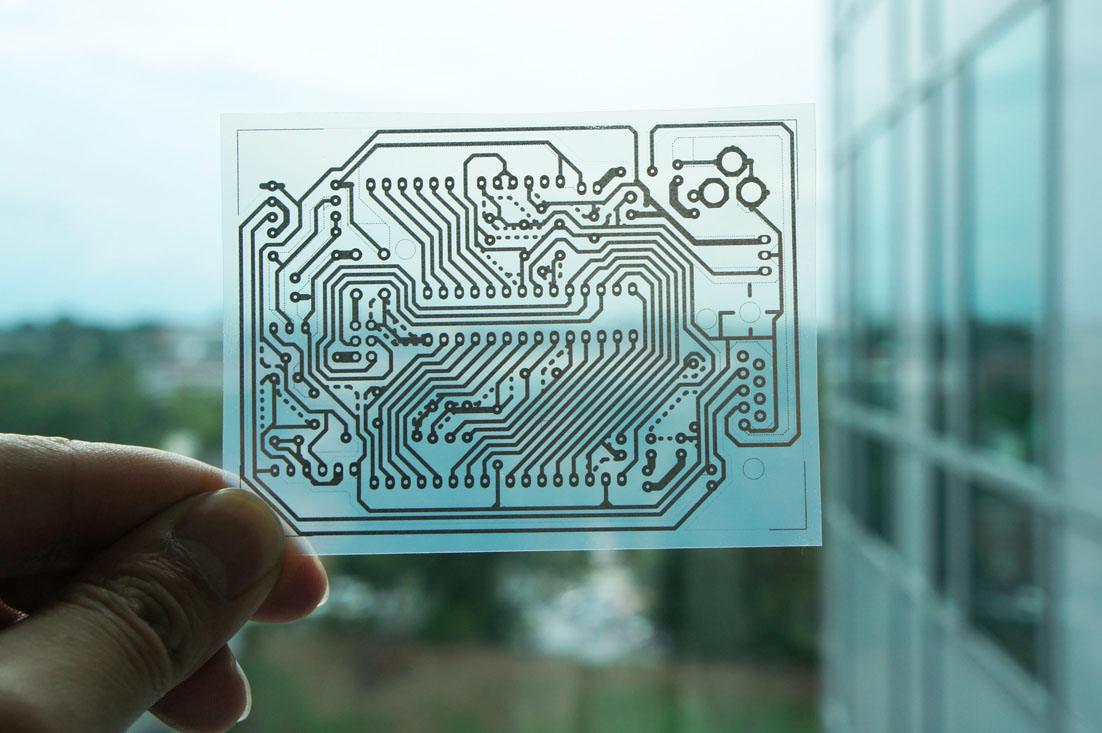
Researchers from Georgia Tech, the University of Tokyo and Microsoft Research have developed a novel method to rapidly and cheaply make electrical circuits by printing them with commodity inkjet printers and off-the-shelf materials. For about $300 in equipment costs, anyone can produce working electrical circuits in the 60 seconds it takes to print them.
The new technique, called as instant inkjet circuits, allows for printing arbitrary-shaped conductors onto rigid or flexible materials so that every one can easily create prototype of the circuits using the commonly available inkjet printer.
Silver nanoparticle ink is injected into an empty cartridge and used in conjunction with an off-the-shelf inkjet printer to enable “instant inkjet circuit” prototyping.
Recent advances in chemically bonding metal particles allowed the researchers to use silver nanoparticle ink to print the circuits and avoid thermal bonding (sintering), a time-consuming and potentially damaging technique due to the heat.
Printing the circuits on resin-coated paper, PET film, and glossy photo paper worked best. Researchers also made a list of materials to avoid, such as canvas cloths and magnet sheets.
“Everything we introduced in our research is available on the market and makes it possible for people to try this at home,” said Yoshihiro Kawahara, Associate Professor at the University of Tokyo and the primary investigator who developed the methodology while in Atlanta.

To make the technique possible, researchers optimized commercially available tools and materials including printers, adhesive tape and the silver ink. Designing the circuit itself was accomplished with desktop drawing software, and even a photocopy of a drawing can produce a working circuit.
Once printed, the circuits can be attached to electronic components using conductive double-sided tape or silver epoxy adhesive, allowing full-scale prototyping in mere hours. The homemade circuits might allow tinkerers to quickly prototype crude calculators, thermostat controls, battery chargers or any number of electronic devices.
“Using this technology in the classroom, it would be possible to introduce students to basic electronics principles very cheaply, and they could use a range of electronic components to augment the experience,” said Steve Hodges, a team member from Microsoft Research. The method can be used to print circuit boards, sensors and antennas with little cost, and it opens up many new opportunities.
Inkjet-printed electronics have been around for the last ten years. However, inkjet-printers which were able to print electronic inks were expensive — on the order of $50 to $100K. This is the first time printing electronic inks has been demonstrated with a start-up cost of several hundred dollar.
“We believe there is an opportunity to introduce a new approach to the rapid prototyping of fully custom-printed circuits,” said Gregory Abowd, Regents’ Professor at Georgia Tech. “Unlike existing methods for printing conductive patterns, conductivity in our technique emerges within a few seconds and without the need for special equipment.”
To show the capabilities of the new technique for capacitive touch sensing – the interaction prominent in smartphone interfaces – and the flexibility of the printed circuits, the researchers attached a capacitive ribbon with embedded inkjet-printed circuits into a drinking glass. The capacitive ribbon sensor formed to the contour of the glass and, when connected to a micro controller, was able to measure how much liquid was left in the glass.
