
Enzyme-linked immunosorbant assay, or ELISA, is a diagnostic tool that identifies antigens such as viruses and bacteria in blood samples. ELISA can detect a number of diseases, including HIV, West Nile virus and hepatitis B, and it is widely used in hospitals. It can also be used to identify potential allergens in food, among other applications.
A team of researchers from the California NanoSystems Institute at UCLA has developed a new mobile phone-based device that can read ELISA plates in the field with the same level of accuracy as the large machines normally found in clinical laboratories.
The research is published online in the journal ACS Nano.
“This mobile platform can be used for point-of-care testing, screening populations for particular diseases, or tracking vaccination campaigns in most resource-poor settings.”

Traditional ELISA testing is performed with small transparent plates that resemble honeycombs, typically with 96 tiny wells. Samples are placed in the wells first, followed by small amounts of fluid containing specific antibodies that bind to antigens in the samples.
These antibodies are linked to enzymes, so when a substance containing the enzyme’s substrate — the molecule the enzyme acts upon — is added, the resulting chemical reactions cause a change in color. This color change is then analyzed to detect and quantify any antigens that may be present.
The new device, which is created with a 3D printer and attaches to a smartphone, illuminates the ELISA plate with an array of light-emitting diodes. The light projects through each well and is collected by 96 individual plastic optical fibers in the attachment.
The smartphone transmits the resulting images to UCLA servers through a custom-designed app. The images are then analyzed by a machine-learning algorithm that the researchers wrote for this purpose, and the diagnostic results are sent back to the phone within about one minute for the entire 96-well plate. The app also creates a visualization of the results for the user.
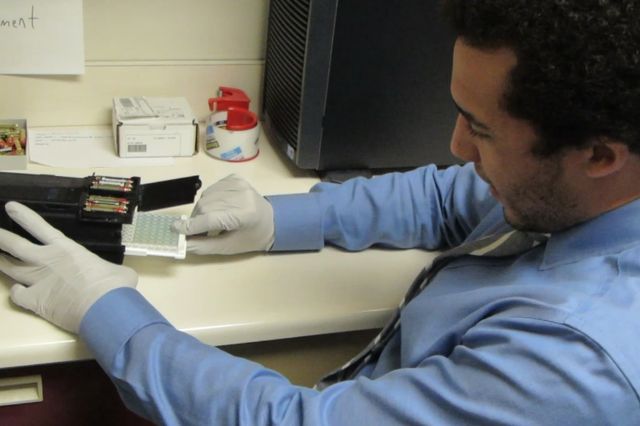
This mobile platform was compared with the standard FDA-approved well-plate readers in a UCLA clinical microbiology laboratory. The ELISA tests included those for mumps, measles, and herpes simplex viruses 1 and 2.
With a total of 571 patient samples used in the comparison, the mobile platform achieved 99.6 percent accuracy in diagnosing mumps, 98.6 percent for measles, and 99.4 percent each for herpes simplex 1 and 2.
This cost-effective and hand-held platform could assist health-care professionals to perform high-throughput disease screening or tracking of vaccination campaigns at the point-of-care, even in resource-poor and field-settings.
“Our team is focused on developing biomedical technologies that work with mobile platforms to assist with on-site testing and health-care in disadvantaged or rural areas”.
