
Fresh food grown in the microgravity environment of space officially is on the menu for the first time for NASA astronauts on the International Space Station.
Expedition 44 crew members, including NASA’s one-year astronaut Scott Kelly, are ready to sample the fruits of their labor after harvesting a crop of “Outredgeous” red romaine lettuce Monday, Aug. 10, from the Veggie plant growth system on the nation’s orbiting laboratory.
The astronauts will clean the leafy greens with citric acid-based, food safe sanitizing wipes before consuming them. They will eat half of the space bounty, setting aside the other half to be packaged and frozen on the station until it can be returned to Earth for scientific analysis.

NASA’s plant experiment, called Veg-01, is being used to study the in-orbit function and performance of the plant growth facility and its rooting “pillows,” which contain the seeds.
NASA is maturing Veggie technology aboard the space station to provide future pioneers with a sustainable food supplement – a critical part of NASA’s Journey to Mars. As NASA moves toward long-duration exploration missions farther into the solar system, Veggie will be a resource for crew food growth and consumption. It also could be used by astronauts for recreational gardening activities during deep space missions.
The first Veg-01 plant pillows were activated, watered and cared for by Expedition 39 flight engineer Steve Swanson in May 2014. After 33 days of growth, the plants were harvested and returned to Earth in October 2014. At NASA’s Kennedy Space Center in Florida, the plants underwent food safety analysis.
The second Veg-01 plant pillows were activated by Kelly on July 8 and grew again for 33 days before being harvested. The seeds had been on the station for 15 months before being activated.

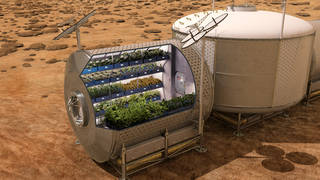
The Veggie system was developed by Orbital Technologies Corp. (ORBITEC) in Madison, Wisconsin, and tested at Kennedy before flight. Veggie, along with two sets of pillows containing the romaine seeds and one set of zinnias, was delivered to the station on the third cargo resupply mission by SpaceX in April 2014.
The collapsible and expandable Veggie unit features a flat panel light bank that includes red, blue and green LEDs for plant growth and crew observation. Using LED lights to grow plants was an idea that originated with NASA as far back as the late 1990s.
The purple/pinkish hue surrounding the plants in Veggie is the result of a combination of the red and blue lights, which by design emit more light than the green LEDs. Green LEDS were added so the plants look like edible food rather than weird purple plants.
Blue and red wavelengths are the minimum needed to get good plant growth. They are probably the most efficient in terms of electrical power conversion. The green LEDs help to enhance the human visual perception of the plants, but they don’t put out as much light as the reds and blues.
“There is evidence that supports fresh foods, such as tomatoes, blueberries and red lettuce are a good source of antioxidants. Having fresh food like these available in space could have a positive impact on people’s moods and also could provide some protection against radiation in space”.
After the first crop of lettuce was returned from the space station, they began working with a team of flight doctors and NASA safety representatives to get approval for the crew to eat the produce.
“Besides having the ability to grow and eat fresh food in space, there also may be a psychological benefit. The crew does get some fresh fruits or vegetables, such as carrots or apples, when a supply ship arrives at the space station. But the quantity is limited and must be consumed quickly.”
The system also may have implications for improving growth and biomass production on Earth, thus benefiting the average citizen.
The team at Kennedy and Johnson hope that Veggie and space gardening will become a valued feature of life aboard the space station and in the future on Mars.
