
Several weeks ago, Sarah Larson from The New Yorker, published a fun article about e-laughter (all the hahas and lols we use to communicate with our friends online) and their social subtleties. Like any “dialect,” e-laughing is evolving. Curious as to whether her usage followed up-to-date social norms, she consulted her savvy friends for answers. Anecdotally, she found that laughter tended to vary by age and gender.
Facebook has analyzed de-identified posts and comments posted in the last week of May with at least one string of characters matching laughter. They did the matching with regular expressions which automatically identified laughter in the text, including variants of haha, hehe, emoji, and lol.
As denizens of the Internet will know, laughter is quite common: 15% of people included laughter in a post or comment that week. The most common laugh is haha, followed by various emoji and hehe.
Age, gender and geographic location play a role in laughter type and length: young people and women prefer emoji, whereas men prefer longer hehes. People in Chicago and New York prefer emoji, while Seattle and San Francisco prefer hahas.
Facebook found that roughly 15% of the people who posted or commented during that week used at least one e-laugh. So it’s pretty common to laugh online.
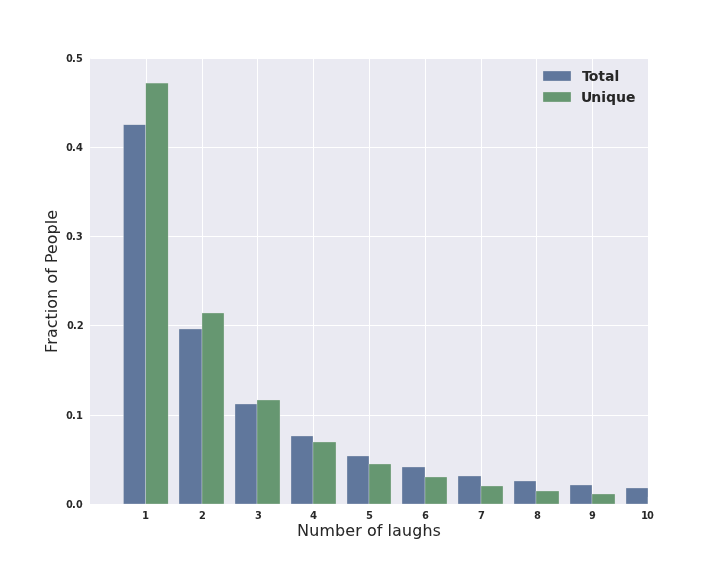
For those people that laughed, Facebook analyzed how many times they laughed. The result indicates that around 46% of the people posted only a single laugh during the week, and 85% posted fewer than five laughs. Facebook also analyzed how many different laughs people used – 52% of people used a single type of laugh, and roughly 20% used two different types.
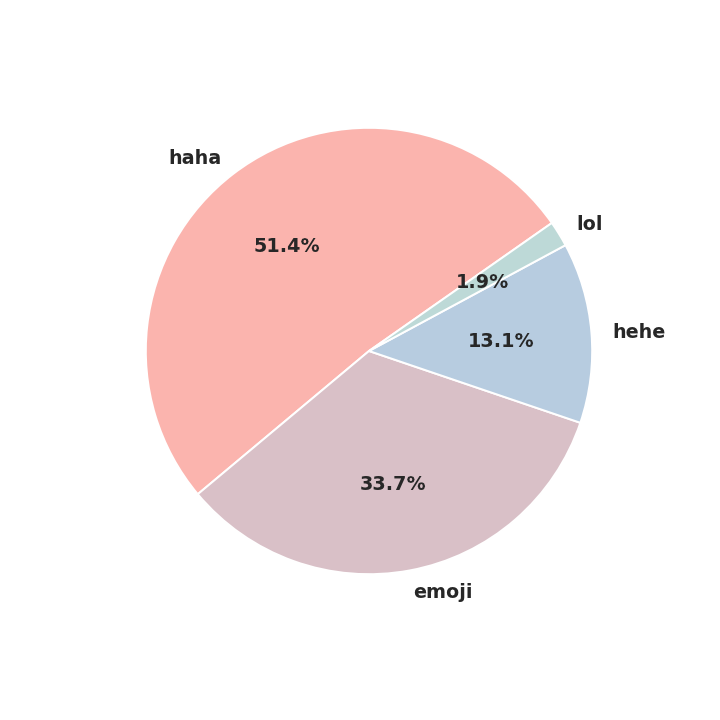
Since most people used a single type of laugh, Facebook classified people into four categories based on their most commonly used laugh. The laughs includes haha, hehe, lol and emoji. Keep in mind that the haha itself includes a wide range of laughs, e.g., haha includes terms like haha, hahaha, haahhhaa, etc. The vast majority of people in the Facebook’s dataset are haha-ers (51.4%), then there are the emoji lovers (33.7%), the hehe-ers (12.7%), and finally, the lol-ers (1.9%).
Ms. Larson discusses the emergence of the peculiar hehe, which is “poised upon us by the youth.” Are the hehes really a more youthful expression than hahas? The data say: not so!
All age groups, from 13 to 70, the most common laughs are still haha, hahaha, hahahaha, and only then followed by hehe. The below plot shows that the median person (the dashed line) that uses emoji is slightly younger than the median haha person, but both of these are younger than the people using hehes and lols!

Ms. Larson also suggests that a ha is like a lego piece, which people use to convey different “levels” of laughter, ranging from the polite haha to a deranged hahahahahahaha. Thus by the lengths of laughs by type:
Indeed, as Ms. Larson points out, the peaks in the even numbers indicate that people treat the has and hes as building blocks, and usually prefer not to add extra letters. No heh hehs here.
The most common are the four letter hahas and hehes. The six letter hahaha is also very common, and in general, the hahaers use longer laughter. The hahaers are also slightly more open than the hehe-ers to using odd number of letters, and also occasionally some using hahaas and hhhhaaahhhaas. The lol almost always stands by itself, though some rare specimens of lolz and loll were found. A single emoji is used 50% of the time, and it’s quite rare to see people use more than 5 identical consecutive emoji.
Finally, Ms. Larson raised the suspicion that hehe is a more masculine laugh, since it’s made up of “a bunch of he’s”. Both men and women like their hahas and emoji, followed by hehes and lols. The hahas and to some extent the hehes are preferred by men, whereas emoji are clearly dominated by women, who also seem to like the lols a bit more than men. So there are patterns in laughter on Facebook, but they are quite different from the anecdotal evidence presented in the New Yorker article.
The difference occurs, may be due to Ms. Larson is hanging out with cool people from New York City. So Facebook plotted the distribution of laughter across a bunch of cities include New York, San Francisco, Boston, Phoenix, Chicago and Seattle.
Indeed laughter varies by city, so Facebook created heatmaps to see the popularity of the different types of laughter across states in the USA.
Thus, Facebook analyzed that haha and hehe are more popular on the west coast, emoji are the weapon of choice in the midwest, and southern states are fond of lol.
Presidential campaigns, take note: the battleground states of Ohio and Virginia are haha states, while the candidates’ emoji games will surely be key in determining who emerges victorious in Florida.
