
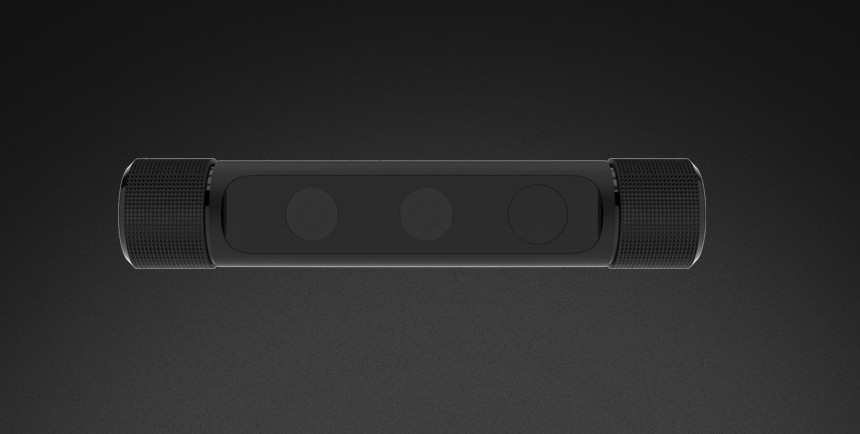
Intel is working with Razer, a world leader in connected devices and software for gamers, to deliver a consumer-ready desktop and VR-enabled camera based on Intel RealSense technology for a wide range of experiential applications.
The announcement is made at the Intel Developer Forum 2015 held in San Francisco.
At the Intel Developer Forum 2015, Intel and Razer have teamed up to showcase multiple broadcasting and OSVR demos using Intel RealSense technology, a modified OSVR Hacker Dev Kit by Razer, powered by computers using Intel processors .
The demos will include both Virtual Reality and Augmented Reality applications running on PCs.
“Razer is working with Intel to deliver an Intel Real Sense Camera peripheral for gamers. The peripheral is a small, light-weight, USB-powered camera optimized for close-range interactivity with a depth sensor for enhanced game broadcasting and virtual reality(VR)gaming capabilities.”
“Gamers can easily mount the peripheral on different machines such as desktop computers and VR headsets.It offers an ideal solution for OSVR developers.The product is scheduled for the first quarter of 2016.”
With Intel RealSense technology incorporated into a new Razer product design, users can expect to enjoy significantly enhanced game broadcasting and VR gaming capabilities.
The automatic background removal allows the game streamers and video conferencing users to remove or replace backgrounds for a more entertaining and immersive experience.
Intel RealSense Cameras are also capable of 3D scanning, motion and gesture recognition, allowing product designers to bring real-world objects and bodies into virtual spaces easily. Many more features and related applications are anticipated for the Intel RealSense technology-enabled Razer device.
Min-Liang Tan, co-founder and CEO of Razer, said:
“Razer is excited to be working with Intel, using Intel RealSense technology to help pioneer work for game broadcasting, as well as with VR, with support from the growing OSVR movement. Gamers will, we expect, be able to enhance their broadcasting and VR experience in unprecedented ways.”
Dr. Achin Bhowmik, General Manager of Perceptual Computing, Intel:
“This is a great opportunity to make Intel RealSense technology easily accessible to the gaming and VR communities. We are proud of the beautiful design of Razer’s Intel RealSense Camera peripheral and we look forward to enabling innovation in the gaming world together.”
Intel RealSense technology makes 3D scanning a reality right from your device, so you can scan and save a piece of art, a flower, a toy—even your own face. You’re able to save your scan as-is, or manipulate it into something new. Then share it digitally, or print a version with the use of a 3D printer.
At the Intel Developer Forum, the company also announced that Intel Optane technology will combine the revolutionary 3D XPointTM non-volatile memory media with the company’s advanced system memory controller, interface hardware and software IP, to unleash vast performance potential in a range of forthcoming products.
“Beginning in 2016, Intel Optane technology will come to market in a new line of high-endurance, high-performance SSDs. The new technology will also power a new line of Intel DIMMs designed for Intel’s next-generation data center platforms.”
