
Skip to content

QualityPoint Technologies News

Emerging Technologies News

Menu
  • About Us
  • Technology
  • Medical
  • Robots
  • Artificial Intelligence (AI)
  • 3D Printing
  • Contact Us
Menu

Huge Discount Offer: 14 ebooks + 2 courses

Lasers enable engineers to weld ceramics, no furnace required

Posted on August 27, 2019

Engineers at the University of California have developed a new ceramic welding technology that can help to achieve Smartphones that don’t scratch or shatter, Metal-free pacemakers, and Electronics for space and other harsh environments.

Their new process uses an ultrafast pulsed laser to melt ceramic materials along the interface and fuse them together. It works in ambient conditions and uses less than 50 watts of laser power, making it more practical than current ceramic welding methods that require heating the parts in a furnace.

Ceramics have been fundamentally challenging to weld together because they need extremely high temperatures to melt, exposing them to extreme temperature gradients that cause cracking.

Ceramic materials are of great interest because they are biocompatible, extremely hard and shatter resistant, making them ideal for biomedical implants and protective casings for electronics. However, current ceramic welding procedures are not helpful to making such devices.
Credit: Garay lab/UC San Diego Jacobs School of Engineering

Right now there is no way to encase or seal electronic components inside ceramics because we would have to put the entire assembly in a furnace, which would end up burning the electronics.

The research team’s solution was to aim a series of short laser pulses along the interface between two ceramic parts so that heat builds up only at the interface and causes localized melting. They call their method ultrafast pulsed laser welding.

To make it work, the researchers had to optimize two aspects: one is, the laser parameters (exposure time, number of laser pulses, and duration of pulses) and the other thing is, the transparency of the ceramic material. With the right combination, the laser energy couples strongly to the ceramic, allowing welds to be made using low laser power (less than 50 watts) at room temperature.

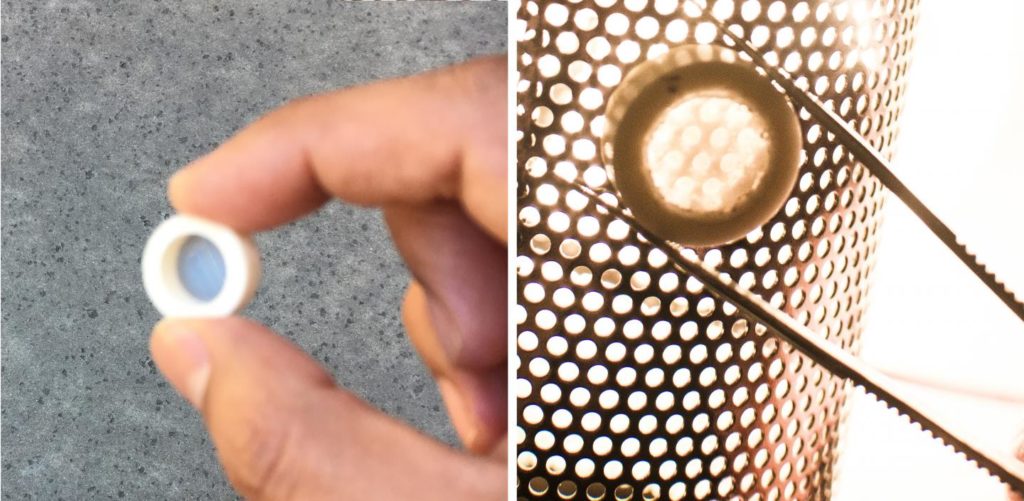
As a proof of concept, the researchers welded a transparent cylindrical cap to the inside of a ceramic tube. Tests showed that the welds are strong enough to hold vacuum.

News Source: Eurekalert

Share

Related News:

  1. Lasers help to Transmit Audio directly into a Person’s Ear without requiring Receiver.
  2. Researchers develop a high-power, portable terahertz laser
  3. Why writing by hand makes kids smarter
  4. Hyperbaric Oxygen Treatments (HBOT) halt aging of blood cells and reverse aging process
Master RAG ⭐ Rajamanickam.com ⭐ Bundle Offer ⭐ Merch ⭐ AI Course

  • Bundle Offer
  • Hire AI Developer

Latest News

  • MIT Researchers Unveil New Framework to Test AI Privacy Risks in Clinical Models January 6, 2026
  • MIT Researchers Develop AI-Driven Robot That Builds Furniture From Text Prompts December 17, 2025
  • Kling O1: A New Breakthrough in AI Video Creation December 4, 2025
  • Coactive: Teaching AI to See and Understand Visual Content June 10, 2025
  • Harvard Sues Trump Administration Over International Student Ban May 23, 2025
  • Stanford Researchers Develop AI Agents That Simulate Human Behavior with High Accuracy May 23, 2025
  • ​Firebase Studio: Google’s New Platform for Building AI-Powered Applications April 11, 2025
  • MIT Researchers Develop Framework to Enhance LLMs in Complex Planning April 7, 2025
  • MIT and NVIDIA Unveil HART: A Breakthrough in AI Image Generation March 25, 2025
  • Can LLMs Truly Understand Time Series Anomalies? March 18, 2025

Pages

  • About Us
  • Basics of 3D Printing
  • Key Innovations
  • Know about Graphene
  • Privacy Policy
  • Shop
  • Contact Us

Archives

Developed by QualityPoint Technologies (QPT)

QPT Products | eBook | Privacy

Timesheet | Calendar Generator

©2026 QualityPoint Technologies News | Design: Newspaperly WordPress Theme