
Inspired by the Japanese art of paper cutting and by taking inspiration from claws and scales found in nature, MIT engineers have designed a friction-boosting material that could be used to coat the bottom of your shoes, giving them a stronger grip on ice and other slippery surfaces.
The researchers drew on kirigami, a variation of origami that involves cutting paper as well as folding it, to create the new coating. Laboratory tests showed that when people wearing kirigami-coated shoes walked on an icy surface, they generated more friction than the uncoated shoes.
Incorporating this coating into shoes could help prevent dangerous falls on ice and other hazardous surfaces, especially among the elderly.
The research paper appears in the journal Nature Biomedical Engineering.
Kirigami is an art form that involves cutting intricate patterns into sheets of paper and then folding them to create three-dimensional structures. Recently, some scientists have used this technique to develop new materials such as bandages that stick more securely to knees and other joints, and sensors that can be used to coat the skin of soft robots and help them orient themselves in space.
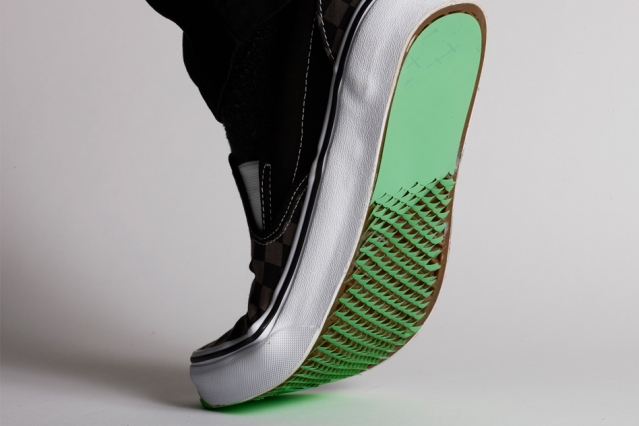
In this case, the team applied this approach to create intricate patterns of spikes in a sheet of plastic or metal. These sheets, applied to the sole of a shoe, remain flat while the wearer is standing, but the spikes pop out during the natural movement of walking.
The novelty of this type of surface is a shape transition from a 2D flat surface to a 3D geometry with needles that come out.
The users can use those elements to control friction, because the sharp needles can pop in and out based on the stretch that they apply.
The researchers created and tested several different designs, including repeating patterns of spikes shaped like squares, triangles, or curves. For each shape, they also tested different sizes and arrangements, and they cut the patterns into both plastic sheets and stainless steel. For each of the designs, they measured the stiffness and the angle at which the spikes pop out when the material is stretched.
They also measured the friction generated by each design on a variety of surfaces, including ice, wood, vinyl flooring, and artificial turf. They found that all of the designs boosted friction, with the best results produced by a pattern of concave curves.
The researchers then used the concave curve coatings for tests with human volunteers. They attached the coatings to a variety of types of shoes, including sneakers and winter boots, and measured the friction produced when subjects walked across a force plate — an instrument that measures the forces exerted on the ground — covered with a 1-inch-thick layer of ice.
They found that with the kirigami coatings attached, the amount of friction generated was 20 to 35 percent higher than the friction generated by the shoes alone.
The researchers are now working on determining the best way to attach and incorporate the kirigami surfaces. They are considering embedding them into the soles or designing them as a separate element that could be attached when needed. They are also exploring the possibility of using different materials, such as a rubber-like polymer with a reinforced steel tip.
While the researchers’ original motivation was preventing slips on icy surfaces, they expect that this kind of shoe grip could also be useful in other settings, such as wet or oily working environments.
News Source: MIT
