
Skip to content

QualityPoint Technologies News

Emerging Technologies News

Menu
  • About Us
  • Technology
  • Medical
  • Robots
  • Artificial Intelligence (AI)
  • 3D Printing
  • Contact Us
Menu

Huge Discount Offer: 14 ebooks + 2 courses

Scientists 3D print self-heating microfluidic devices

Posted on December 11, 2023

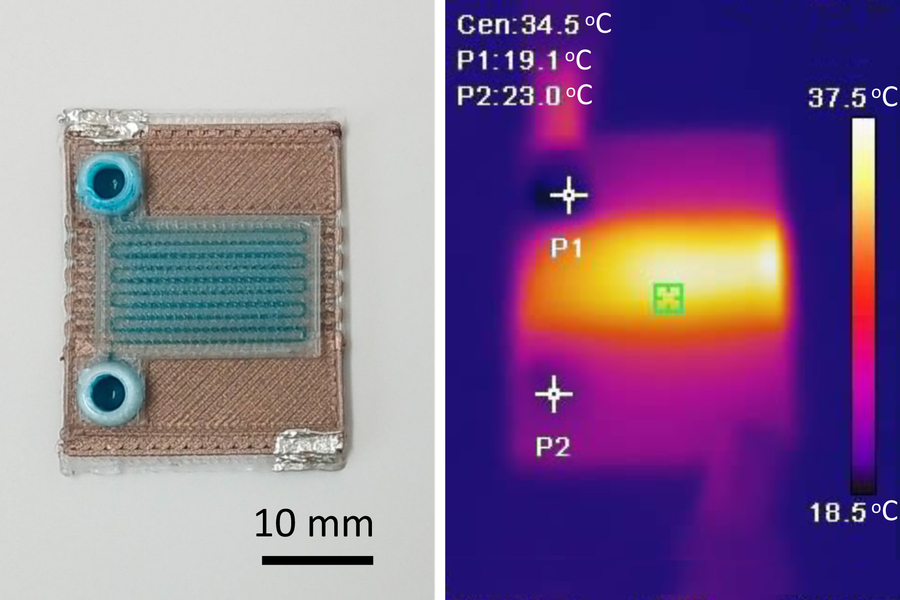
MIT researchers have used 3D printing to produce self-heating microfluidic devices, demonstrating a technique which could someday be used to rapidly create cheap, yet accurate, tools to detect a host of diseases.

Microfluidics, miniaturized machines that manipulate fluids and facilitate chemical reactions, can be used to detect disease in tiny samples of blood or fluids. At-home test kits for Covid-19, for example, incorporate a simple type of microfluidic.
Credit: MIT

But many microfluidic applications require chemical reactions that must be performed at specific temperatures. These more complex microfluidic devices, which are typically manufactured in a clean room, are outfitted with heating elements made from gold or platinum using a complicated and expensive fabrication process that is difficult to scale up.

Instead, the MIT team used multimaterial 3D printing to create self-heating microfluidic devices with built-in heating elements, through a single, inexpensive manufacturing process. They generated devices that can heat fluid to a specific temperature as it flows through microscopic channels inside the tiny machine.

Their technique is customizable, so an engineer could create a microfluidic that heats fluid to a certain temperature or given heating profile within a specific area of the device. The low-cost fabrication process requires about $2 of materials to generate a ready-to-use microfluidic.

The process could be especially useful in creating self-heating microfluidics for remote regions of developing countries where clinicians may not have access to the expensive lab equipment required for many diagnostic procedures.

News Source: MIT

Read below some related News:

MIT’s Microfluidics device helps diagnose sepsis in minutes
MIT’s Microfluidic Device distinguishes Cells based on how they respond to Acoustic Vibrations
Simple device monitors health using sweat
Credit-card-sized genetic microlab can detect COVID-19 in minutes
Share

Related News:

  1. Google starts “YouTube for Schools”
  2. Google shuts Photo-Sharing Service Picnik, Plus More Products
  3. Physicists produce stable water-based graphene dispersions
  4. Turning faces into thermostats to provide more comfort with less energy
Master RAG ⭐ Rajamanickam.com ⭐ Bundle Offer ⭐ Merch ⭐ AI Course

  • Bundle Offer
  • Hire AI Developer

Latest News

  • MIT Researchers Unveil New Framework to Test AI Privacy Risks in Clinical Models January 6, 2026
  • MIT Researchers Develop AI-Driven Robot That Builds Furniture From Text Prompts December 17, 2025
  • Kling O1: A New Breakthrough in AI Video Creation December 4, 2025
  • Coactive: Teaching AI to See and Understand Visual Content June 10, 2025
  • Harvard Sues Trump Administration Over International Student Ban May 23, 2025
  • Stanford Researchers Develop AI Agents That Simulate Human Behavior with High Accuracy May 23, 2025
  • ​Firebase Studio: Google’s New Platform for Building AI-Powered Applications April 11, 2025
  • MIT Researchers Develop Framework to Enhance LLMs in Complex Planning April 7, 2025
  • MIT and NVIDIA Unveil HART: A Breakthrough in AI Image Generation March 25, 2025
  • Can LLMs Truly Understand Time Series Anomalies? March 18, 2025

Pages

  • About Us
  • Basics of 3D Printing
  • Key Innovations
  • Know about Graphene
  • Privacy Policy
  • Shop
  • Contact Us

Archives

Developed by QualityPoint Technologies (QPT)

QPT Products | eBook | Privacy

Timesheet | Calendar Generator

©2026 QualityPoint Technologies News | Design: Newspaperly WordPress Theme