
There are many types of light — some visible and some invisible to the human eye. For example, our eyes and brain don’t have the tools to process ultraviolet light when it hits our eyes, making it invisible. But there is another type of light that is invisible simply because it never reaches our eyes. When light hits certain surfaces, part of it sticks and remains behind rather than being transmitted or scattered away. This type of light is called near-field light.
Today, near-field light is mostly used for ultra-high-resolution microscopy, known as the near-field scanning optical microscopes (NSOM). However, near-field light also has untapped potential for particle manipulation, sensing, and optical communications. But since near-field light doesn’t reach our eyes like far-field light does, researchers haven’t developed a comprehensive toolkit to harness and manipulate the near field.
Now, Harvard SEAS researchers have developed a system to mold near-field light — opening the door to unprecedented control over this powerful, largely unexplored type of light. The research is published in the journal Science.
In order to manipulate near-field light, the researchers developed a device in which light confined to a waveguide bounces back and forth between two reflectors. After each bounce it changes mode, meaning it propagates with a different spatial pattern. With multiple bounces, these patterns add up to generate a complex light intensity profile along the waveguide. The near field light near the surface of the waveguide also changes. When all the different patterns of the near-field light are superimposed on each other, a specific shape is created. The researchers can pre-program that shape by tailoring the amplitude of the modes of the bouncing light.

It’s a bit like music. The music that we are hearing is the superposition of many notes or modes assembled in patterns conceived by the composer. One note alone isn’t much but taken together we can generate any type of music. While music operates in time, the near-field generator operates in three-dimensional space and the extra intriguing aspect of this device is that one note generates the other.
Importantly, this molding process happens remotely, meaning no part of the device directly interacts with the near-field light. This reduces interference, which is important for applications such as particle manipulation, and is a major departure from current local methods of sculpting near fields such as shining light on metallic tips and nanoparticles.
To demonstrate their design, the researchers molded near-field light into the shape of an elephant.
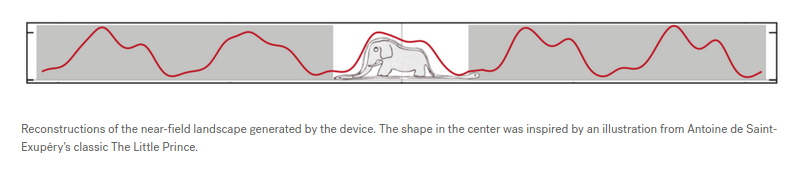
The researchers also shaped the light into a curve, a plateau and a straight line.
This research provides a new path towards unprecedented three-dimensional control of near-field light.
The Harvard Office of Technology Development has protected the intellectual property relating to this project and is exploring commercialization opportunities.
News Source: Harvard
