
Engineers at Oregon State University have combined innovative optical technology with nanocomposite thin-films to create a new type of sensor that is inexpensive, fast, highly sensitive and able to detect and analyze a wide range of gases. This was published in journal of Material Chemistry.
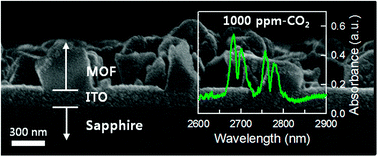
Combined plasmonic nanocrystals and metal–organic framework(MOF) thin-films are fabricated for sensing gases(carbon dioxide) in the near-infrared range. This nanocomposite thin-film shows a highly sensitive response in near-infrared absorption, which is attributed to preconcentration of gas molecules in metal–organic framework pores causing close proximity to the electromagnetic fields at the plasmonic nanocrystal surface.
Optical sensing is very effective in sensing and identifying trace-level gases, but often uses large laboratory devices that are terribly expensive and can’t be transported into the field.
By contrast, we use optical approaches that can be small, portable and inexpensive. This system used plasmonic nanocrystals that act somewhat like a tiny lens, to concentrate a light wave and increase sensitivity.
This approach is combined with a metal-organic framework of thin films, which can rapidly adsorb gases within material pores, and be recycled by simple vacuum processes. After the thin film captures the gas molecules near the surface, the plasmonic materials act at a near-infrared range, help magnify the signal and precisely analyze the presence and amounts of different gases.
By working at the near-infrared range and using these plasmonic nanocrystals, there’s an order of magnitude increase in sensitivity. This type of sensor should be able to quickly tell exactly what gases are present and in what amount.
That speed, precision, portability and low cost, should allow instruments that can be used in the field for many purposes. The food industry, for industry, uses carbon dioxide in storage of fruits and vegetables, and the gas has to be kept at certain levels.
Gas detection can be valuable in finding explosives, and new technologies such as this might find application in airport or border security. Various gases need to be monitored in environmental research, and there may be other uses in health care, optimal function of automobile engines, and prevention of natural gas leakage.
